Certi-Fire is the Ontario-based, compliance-grade certification program developed for regulated fire-alarm practitioners. Their work is constrained by mandatory inspections, formal enforcement mechanisms, and statutory life-safety obligations.
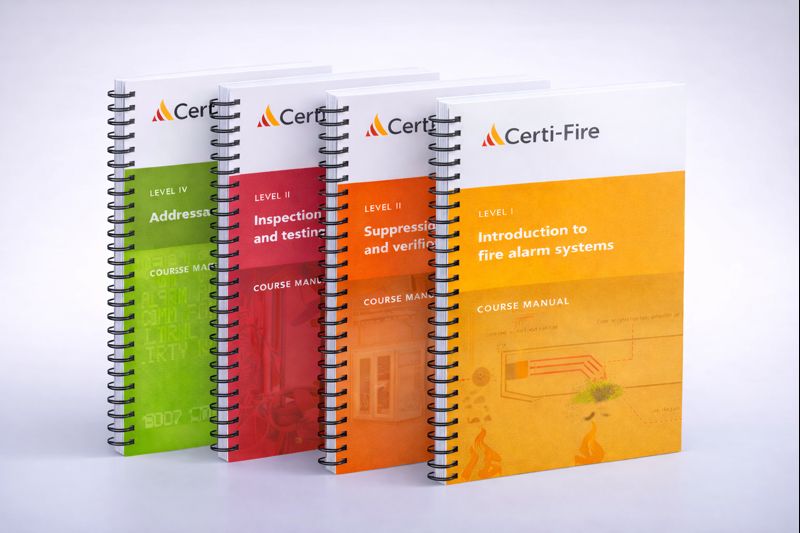
Funded and administered at the provincial level, this province-wide program trains electrical professionals responsible for the design, installation, testing, verification, and inspection of fire-alarm systems.
For program governors, learner decisions carry regulatory, operational, and life-safety consequences. Misinterpretation, inconsistent emphasis, and incomplete guidance are not acceptable.
Engagement scope
Responsibility for the design and authoring of the Certi-Fire program spanned 4 certification levels and 36 modules, and comprised more than 1,400 pages of instructional content.
Worked as part of a small, tightly integrated delivery team that consisted of 3 engineer-facilitators and a single accountable courseware developer.
Responsibilities beyond writing included:
- Instructional architecture
- Assessment alignment
- Content layout and module templating
- Coordination of review and revision cycles
The immediate priority was a successful program launch under scheduled timelines and regulatory expectations.
Delivery challenge
The core challenge was governance under pressure.
The program needed to support:
- Consistent interpretation of overlapping codes and standards
- Traceability from regulatory language to instructional guidance
- Structured review and correction across large, interdependent documents
This required disciplined coordination rather than ad hoc content exchange.
Instructional and review approach
Developed a structured instructional framework based on:
- Formal needs assessment
- Practitioner role analysis
- Mapping regulatory language to practitioner decision points
Delivery responsibility included authoring all instructional layouts and module templates within the Certi-Fire identity system to ensure:
- Consistent visual hierarchy
- Controlled instructional emphasis
- Predictable learner navigation across modules and levels
To support team coordination and accountability, established password-protected Adobe and Microsoft collaboration spaces to manage shared reviews, content responsibility status tracking, and centralized error reporting.
Outcomes
The resulting program supports consistent learner decision-making, structured review cycles, and defensible instructional alignment in a regulated environment.
The manual is fantastic, and I’m really looking forward to using this.
Mark Steane — Certi-Fire Program Manager
